We live in a world drowning in data. Emails, reports, books, online courses, social media posts—all competing for our attention. Yet, despite this endless stream of information, true learning often feels elusive.
Why? Because learning isn’t just about collecting data—it’s about transforming it into wisdom.
One of the simplest yet most profound models that explains this transformation is the DIKW Pyramid—Data, Information, Knowledge, Wisdom. It shows us how raw facts evolve into deep understanding and actionable insights.
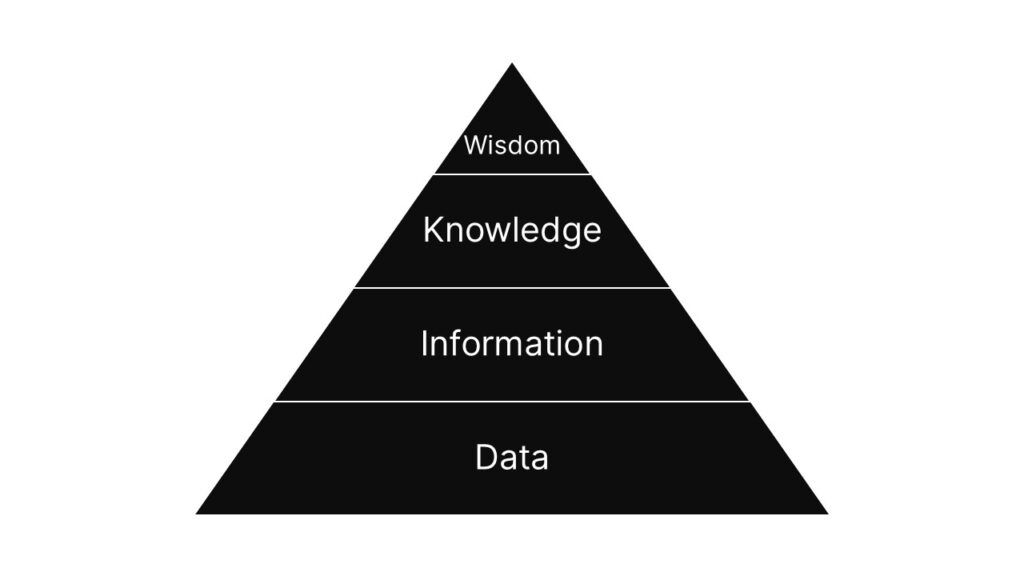
Step 1: Data – The Raw Materials of Learning
Think of data as scattered puzzle pieces. Numbers, words, statistics, and isolated facts. They exist, but they don’t mean much on their own.
For example, imagine you’re tracking your learning habits. You record that you studied for 2 hours on Monday, 1.5 hours on Tuesday, and 45 minutes on Wednesday. These numbers are just data points—they tell you what happened but not why it matters.
Step 2: Information – Connecting the Dots
Data becomes information when you start organizing it in a meaningful way.
You might notice that on the days you studied in the morning, you retained more, while late-night sessions resulted in poor focus. Now, instead of just seeing numbers, you recognize a pattern: time of study impacts effectiveness.
This is where most people stop. They collect information, but they don’t know what to do with it.
Step 3: Knowledge – Understanding the Why
Information becomes knowledge when you internalize and apply it.
Now that you know morning study sessions are more effective, you start restructuring your schedule. You prioritize deep learning in the mornings and save lighter tasks for the evenings.
At this stage, learning is no longer passive—it’s intentional.
Step 4: Wisdom – Knowing When and How to Apply Knowledge
Wisdom is the highest level. It’s the ability to apply knowledge in the right context.
Let’s say you’re mentoring a junior colleague who struggles with learning retention. Instead of bombarding them with study tips, you ask:
“What time of day do you focus best?”
Rather than giving generic advice, you guide them based on real insights from your own experience. Wisdom is about using knowledge with judgment, experience, and foresight.
Why This Matters in Learning
Many people get stuck at the data and information levels, consuming more books, courses, and articles without ever translating them into knowledge and wisdom.
To truly learn, ask yourself:
- Am I just collecting facts, or am I seeing patterns?
- Am I applying what I learn, or just storing it?
- Am I making decisions based on knowledge, or am I still relying on random information?
Bridging the Gap: How to Move from Data to Wisdom in Learning
- Stop Overloading on Information – More isn’t always better. Instead of reading 10 books, deeply apply 1.
- Reflect on What You Learn – Ask, How does this apply to my life?
- Experiment and Adjust – Learning happens in action, not just in theory.
- Teach What You Know – The fastest way to transform knowledge into wisdom is to explain it to others.
Final Thoughts
True learning isn’t about hoarding data—it’s about turning insights into meaningful action. The next time you come across new information, don’t just store it. Think, apply, refine.
Because at the end of the day, wisdom is not just knowing—it’s doing.